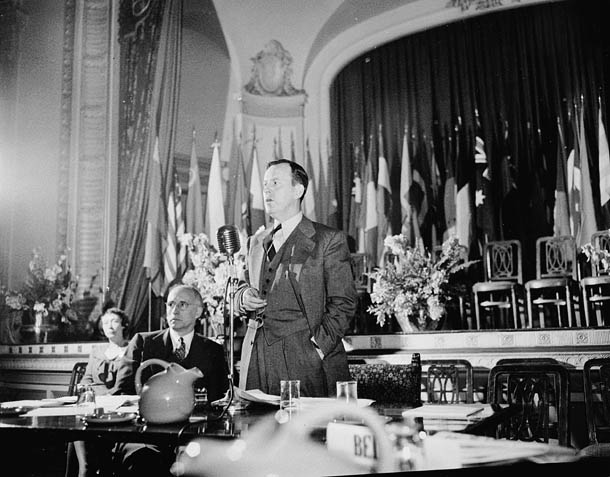
On the 20th January 2026, Canadian Prime Minister Mark Carney delivered a speech at the 2026 World Economic Forum in Davos, Switzerland. Titled “Principled and Pragmatic: Canada’s Path,” Carney’s speech was a call to action for middle powers of the globe to unite in the face of a “rupture” in the current world order, encouraging cooperative agreements that decrease the reliance of middle powers on hegemons.
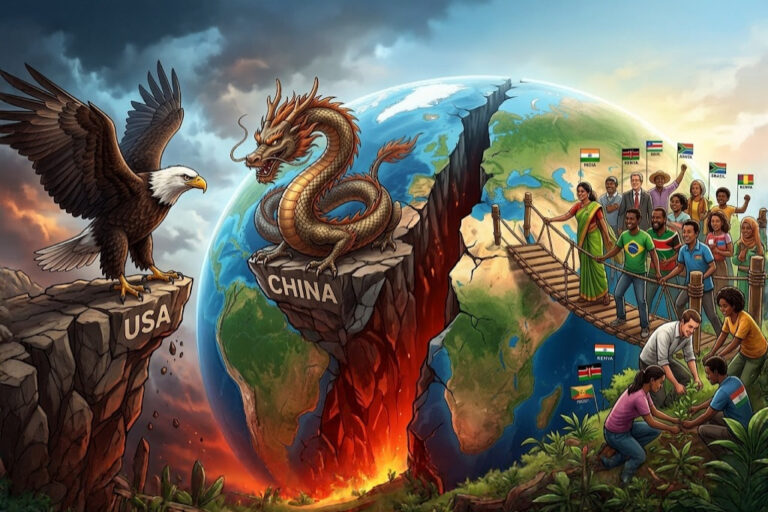
The speech alludes to a masked denunciation of the current US-China hegemons and the erratic foreign policy of the second Trump Administration. A major criticism is levelled at “great powers [that] have begun using economic integration as weapons, tariffs as leverage, financial infrastructure as coercion, [and] supply chains as vulnerabilities to be exploited.” Carney describes a “rupture, not a transition,” of the rules-based global order championed by the USA in the post-Second World War era. His main observation lies in the complicit middle powers1 that maintain the “lie” of this rules-based world order, where the “strongest would exempt themselves when convenient”. Therefore, he announces Canada’s path of multilateralism with other middle powers, beyond the horizons of any hegemon, to foster “genuine cooperation” that would strengthen the middle powers against an increasingly hostile international environment as “if we’re not at the table, we’re on the menu.”
The rules-based order (RBO) that Carney refers to describes the structure of international relations and multilateralism led by the USA after the Second World War. This includes the foundation of organisations such as the UN, World Trade Organisation and International Monetary Fund. These organisations were used to spread economic liberalism to the world, and their success is traced, for example, through the economic liberalisation of Japan, which developed from a sworn enemy to a close ally. The principles of RBO lie not only in Liberal Values: political liberalism, open markets, freedom, human rights, and democracy, but also shared norms, where nations are expected to adhere to treaties, international law, and agreed-upon norms for resolving conflict and conducting trade. However, the middle powers that benefited from this American hegemon are faced with increasingly hostile coercion and abandonment, with US Secretary of State Mark Rubio stating the US would no longer seek to “prop up the entire world order like Atlas.”
To trace the milestones of history towards the abandonment of a world order America itself created, we must understand the original purpose of this world order. In the post-war and Cold War eras, America developed a seeming necessity to liberalise the world and expand its hegemonic power to combat the growing influence of the Soviet Union. The RBO was therefore a product of an ideological union against the Soviets, headed by the United States. Following the gradual decline of the Soviet Union throughout the 1980s and 90s, satellite nations began to align with the RBO to develop their economies, further propping up America as the hegemon that glued the global order together. But what happens when the glue begins to fray, and the parts come apart? This is the precise problem Carney aims to address with this speech. This article thus asks: Is Carney’s vision of middle powers working around the global hegemons realistic? And with a hegemon historically required to shape a global order, can this union truly take their place? What would that look like?
Carney’s argument begins with an excerpt from Václav Havel’s The Power of the Powerless. In it, he asks why the soviet system was able to sustain itself in Czechoslovakia for such a long time. The former Czech President wrote of an image in which a shopkeeper brandishes a sign in their window that reads “workers of the world unite!” And so follow the other shopkeepers, a small yet powerful symbol of compliance. Each shopkeeper knows their system is failing, but brandishes the sign anyway — to avoid trouble. The ritualistic compliance of ordinary people is what allows the system to maintain, in other words, “living within a lie.” The lie itself is only as strong as those who perform it. Thus, Carney encourages the middle powers to take down their signs, acknowledge the ‘lies’ within the current global order and stop performing for the hegemons that exempt themselves from the rules as they see fit, and leverage their power to enforce subordination. Carney accentuates that this is not acceptable in a productive relationship between nations. The question raised here is whether Carney is suggesting that the rules-based order has always been a lie, or whether the rupture, attributable to the current turbulent US foreign policy and the rise of China, is only now unearthing a failing system that requires change. Is he suggesting that middle powers have always had their signs up, or that they’ve been put up recently? In either case, Carney argues that performing within this system with full knowledge of its lies perpetuates the increasing subordination of middle powers.
This leads us to the question: What is the solution for the middle powers, and what does Carney’s vision look like? Firstly, Carney’s vision is dependent on multilateral trade and information sharing between the middle powers. On the one hand, it is perfectly realistic for the middle powers to trade food, goods, and resources required for everyday life to function. For example, the UK imports about 70% of its food from the EU, and other goods from the rest of the world include lamb, famously imported from New Zealand. On the other hand, when it comes to critical goods such as machinery and semiconductors, the middle powers are largely reliant on the hegemons. What is more, middle powers like Japan and Taiwan rely on the US to maintain their security. With proximity to China and the looming presence of the CCP and its subversive practices in their nations, Japan and Taiwan may be reluctant to strain their relationship with the US, despite their hostile foreign policy. To provide a contrary example, the Netherlands has recently limited their intelligence sharing with the US as a response to US aggression in South America and the somewhat unpredictable stance of President Trump on Russia, previously urging Ukrainian President Volodymyr Zelenskyy to accept Putin’s terms to end their war. This establishes that some middle powers could benefit more than others from a shift away from hegemons, particularly from a Western perspective and deepens the complexity of the future Carney is modelling. Some nations may therefore be hesitant to join unions of middle powers, undermining the collective potential strength as a point of competition and self-determination against the hegemons.
Thus, a large problem with modelling Carney’s idea of a new world order lies in dissecting his approach to ‘Value-based Realism’. The term has been borrowed from Finnish President Alexander Stubb and is based on striking a balance between realpolitik and naïve idealism. A more contemporary analysis of this balance would be between profit and values. The source of coercion that middle powers experienced is traced to the influence of commerce and profit. So a key question for Carney’s vision is: would businesses be able to benefit from a middle powers union, or would it require significant government backing to function? Would it therefore be permissible to expect many middle powers to agree to these unions instead of the short-term benefit of continuing to purchase from hegemons? On top of this viability issue, Carney proposes that these unions are values-based. I wholeheartedly reject the notion that there is something naive or idealistic about cooperation between nations based on aligning values, and further, it is fundamentally necessary for Carney’s vision to work. The meaning of values-based realism applied by Carney is thus about striking a balance between what unions and deals are profitable and sustainable for each nation, and then to what extent their values align on a given issue(s). The question about viability rests on whether values are sacrificed for profitability, which is often a resounding yes.
Carney’s vision for a new global world order is bold and certainly a welcome prospect. Given that Carney’s message is delivered on the largest stage, with an illuminating analysis of how China and the USA enforce subordination as hegemons, it makes the prospects all the more potent. The issues highlighted in this vision surround the propensity of other nations to embark on this path alongside Canada, striking a balance between what values are willing to be sacrificed for profit. And this is the factor on which analyses deem his future to be ‘realistic’. There are avenues in which Carney’s vision is certainly realistic, yet there are different levels of value on the table for each middle power. Beyond the necessity of profitable deals, diverting from the hegemons poses security risks for some nations. Will Carney have to convince them on a level of socio-political values, or let the numbers do the talking?
Given this article questions the sustainability of Carney’s vision. It may be more appropriate to consider the hostility of the contemporary hegemons, my question is whether the potential success of Carney’s unions could be their downfall.
- The ‘Middle powers’ Carney refers to are nations that have large economies and significant technological, trade and diplomatic influence, but lack the power of hegemony, such as the UK, Brazil, Japan, South Korea, etc. ↩︎