Do we imagine ourselves in other people’s shoes too much?
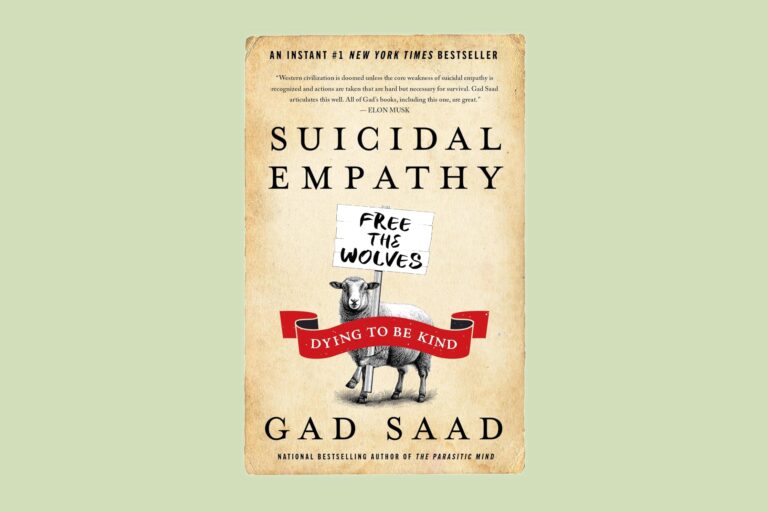
A recent book by Canadian professor Gad Saad, titled ‘Suicidal Empathy: Dying to be Kind’ has suggested that many of the world’s woes stem from people caring too much about other people. Saad argues that empathy is often inappropriate in the modern world.
He joins a list of several academics, thinkers and polemicists who believe people care too much. In 2016, Paul Bloom’s ‘Against Empathy’ made similar points, but with more nuance and finesse. Nativist politicians in the UK and US have also written against empathy. Many are especially concerned when we show an understanding for people from different cultures or ethnic backgrounds. Anti-empathy movements often flourish in civil conflicts, when activists find reasons why people shouldn’t sympathise with ‘others’.
History suggests that the neutralisation of empathy can lead to atrocities.
But is there an intellectual basis for moving against empathy, as Saad suggests? The Canadian professor tries to root his thinking in evolutionary psychology. Empathy, he opines, in line with a broad academic consensus, is a human trait which has become widespread because it confers evolutionary benefits. A community of people who are empathetic is more likely to survive and propagate than a set of individuals who cannot imagine each other’s concerns. Since we’re all descended from the survivors, we have all inherited the empathy gene, some more than others.
Saad then argues, more controversially, that empathy is less appropriate today, because society has changed. Is this a legitimate move?
It’s not, and for two reasons. First, Saad is voicing another evolved trait, and trying to justify his preference for it. As well as evolving a sense of empathy between members of a community, most humans have also evolved a potential to be hostile to outsiders. Group loyalty, often backed up by a potential for violence in mutual defence, can be found on all continents. Almost all humans can be provoked to have negative emotions for someone who is different from them. Saad is simply trying to promote this inherent tendency to show hostility to others over empathy itself. We can all prefer one emotion over another; it doesn’t make that choice right, any more than saying strawberries are better than raspberries.
Which is where the second, and more important flaw, in Saad’s reasoning comes in. Saad is exposing a vision of society, and making the case that one form of society is better than another. This, in itself, is reasonable: almost everyone has views on how society should be. But we must acknowledge that those views are themselves the result of a blend of several factors, not just reasoning. The well spring of our values is usually either the same evolutionary psychology which gave rise to empathy, or the culture and upbringing which has interpreted and translated that over many generations of social experimentation. All of those have large arbitrary elements to them. In other words, Saad struggles to explain why his ‘anti-empathy’ approach is any more well founded than the words of those he opposes.
A different and more optimistic approach was set out by philosopher Roman Krznaric in his 2014 book, ‘Empathy: A Handbook for Revolution’. Krznaric argues that empathy can generate a revolution in human relationships, and transform the brains of who expose the sentiment. His key insight is that, as well as leading to generosity, likely to help those lucky enough to know empathic individuals, those individuals will themselves benefit from the mental changes brought on by empathy. In these terms, rather than being ‘suicidal’, as Saad claims, empathy is life-affirming.
Empathy sits alongside several traits and emotions which have their place and time. Greed, love, honour, politeness, bravery: we can have too much of each of them, as well as too little. Much moral philosophy involves trying to apply reason to these traits, so that they can be civilised. We can test for consistency in how these emotions are applied; we can check from hypocrisy; and we can try to compare them, to see which one wins out in different situations. That’s what ethics is about.
And when it comes to empathy, most societies have already given fairly clear verdicts. In Britain, the highest military honour, the Victoria Cross, is reserved for those who perform an act of bravery which is rooted in suicidal bravery. Most recipients of the US Medal of Honor have died for their empathetic heroics. And throughout Europe, the greatest respect goes to those who acted on the greatest empathy, by ‘laying down one’s life for one’s friends’.
Gad Saad is correct that empathy may, on occasion, be suicidal, but that doesn’t mean empathy is a bad thing. There may even be times when ‘dying to be kind’ is actually the right thing to do.