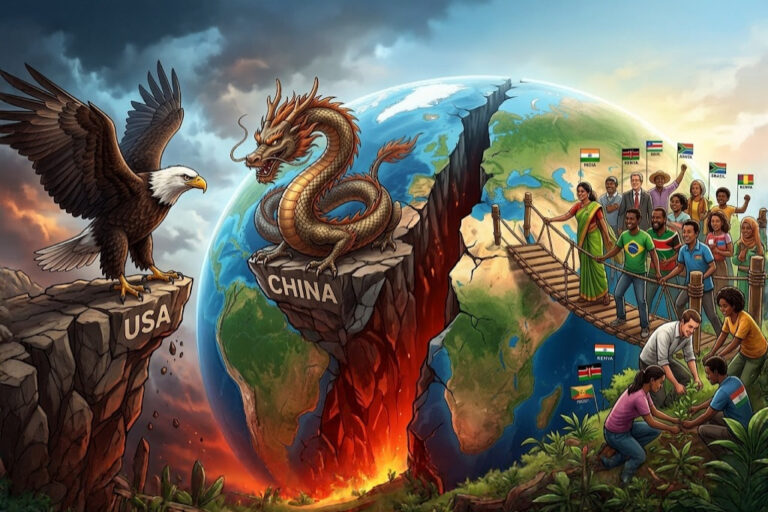
Sandra Khadhouri, Adviser on political communications, and director of Keeping Channels Open, a transatlantic dialogue network, argues that being ethical boosts a country’s soft power, partnerships and national cohesion, with wide-ranging benefits. But this needs to be better demonstrated.
The far right, populists and authoritarians are keen to portray policies aimed at supporting equality, cooperation and shared prosperity as ‘woke,’ unfair and weak. According to their view, worrying about fellow citizens both at home and abroad is holding back progress for the majority. Why should we care about those outside our tribe, the argument goes, when we’re already squeezed? Not our problem.
The swift dismantling of USAID was a clear example of a cynical move designed to send a message that the US no longer feels an obligation to support people outside its borders. The effects on human suffering were immediate and clear; the reputational damage and other knock-on effects, such as the increased spread of disease, terrorism or migration flows caused by instability, could ultimately impact the US too.
So what if we could demonstrate that ‘doing the right thing’ and integrating ethics into politics and international affairs actually makes countries stronger, safer and more prosperous? Ethics is not simply about altruism. Trust, reliability, reciprocity, social cohesion and reputation are strategic assets.
We can already point to concrete examples of losses caused by actions pursued in the name of pure national interest without regard to others. The US imposition of tariffs worldwide, aimed at levelling trade deficits and onshoring manufacturing, has imposed significant costs of its own. Hundreds of thousands of US businesses have reported increased costs, some of which are passed on to consumers. According to the Tax Foundation, while tariffs could raise $1.4 trillion for the government over the next decade, tariffs increased taxes by an average of $1,000 per US household in 2025. Court challenges have also created considerable uncertainty and forced the repayment of some tariff revenues to businesses, though not consumers.
America’s likeability, trust and predictability have also been reduced by threats towards Greenland and Canada, efforts to secure resources in Venezuela and Ukraine, and its aggressive policy of deporting undocumented migrants. Tourism to the US fell in 2025, particularly from Mexico, Canada and Germany. Whether America’s more transactional and predatory approach helps it garner more treasure in the short term is possible, but the loss of long-term partnerships, collaboration and reputation carries a more sustained and broader cost across many areas.
In terms of security, while the US may save money through reduced contributions to European security and NATO, relinquishing US leadership and reliability can exact a cost of its own. European allies are increasingly looking to strengthen their own defence industries and diversify procurement away from dependence on the US. There has also been less support for American military actions, including against Iran. A reduction in access to international US bases will also inhibit future American actions, making them more difficult and expensive.
Israel’s loss of soft power is also yielding a range of impacts. Its deployment of hard power demonstrated strength after the October 7 massacres and enabled Israel to act against and deter its enemies. However, widespread perceptions that its conduct of the war in Gaza has been excessive and neglectful of civilian suffering have carried a severe reputational cost, with potential security and economic implications. Trade sanctions and boycotts are being discussed in Europe and elsewhere. Erosion of support among allies in the region and beyond, including within the US, could also have long-term security implications. It remains to be seen whether Israel can rebuild the strategic support it needs to survive and thrive into the future.
It is undeniable that an ethical foreign policy can also be costly: absorbing a million Syrian refugees into Germany from 2015 onwards, for example, or millions of Ukrainians into neighbouring states after Russia’s full-scale invasion. But we need to better demonstrate the benefits. In Germany, studies show that the integration of Syrians has delivered substantial labour-force growth, increased tax revenues and helped provide workers for an ageing society.
Conversely, anti-immigration sentiment sweeping Europe carries a cost. A French video circulating on social media illustrates how many vital pillars of society depend on immigrant labour. Similarly, America’s hostile immigration policy is contributing to labour shortages and lost economic output. According to US research, previous mass deportations lowered wages of some US-born workers and contributed to job losses. This all suggests that an ethical and well-managed approach towards migration can help countries attract and retain people who contribute to the economy and public good.
Unethical political practices at home also bear a cost. The manipulation of information, including by politicians, helped lead to the UK’s departure from the EU, which weakened the UK economy and undermined the dividends of facilitated cooperation. The drive towards fragmentation of the UK and Europe continues to play out to the detriment of both. Stronger together is not just a slogan. Close cooperation and pooling of resources can enhance national power, prosperity and sovereignty.
More broadly, fomenting polarisation to gain power increases tensions and undermines cooperation and trust. Social cohesion is a security, democratic and economic asset. Functioning democracies need sufficiently cooperative societies in which people are willing to work together, pay taxes and adhere to common rules and standards.
Unethical policies may seem beneficial in the short term, but in the long run can create more problems than they solve. Colonial behaviours and predatory practices are no longer tolerated in the way they were in the 19th century. Counter-productive policies also waste time and energy that could be spent finding more effective ways to spread progress, address challenges and enhance quality of life for greater numbers of people.
To conclude, soft power undergirded by an ethical foreign and domestic policy is radically underestimated as a source of national strength that can generate concrete benefits. An ethical foreign policy is not an alternative to national interest or hard power, but an enhancement. Trust, legitimacy, reliability and social cohesion help make both national power and prosperity sustainable.
We need to start demonstrating that being principled, humane, values-driven and moral – any term but ‘woke’ – can ultimately make us stronger, safer and more prosperous. If doing the right thing for its own sake is not enough of a draw for some people, perhaps those hard-nosed arguments will be.