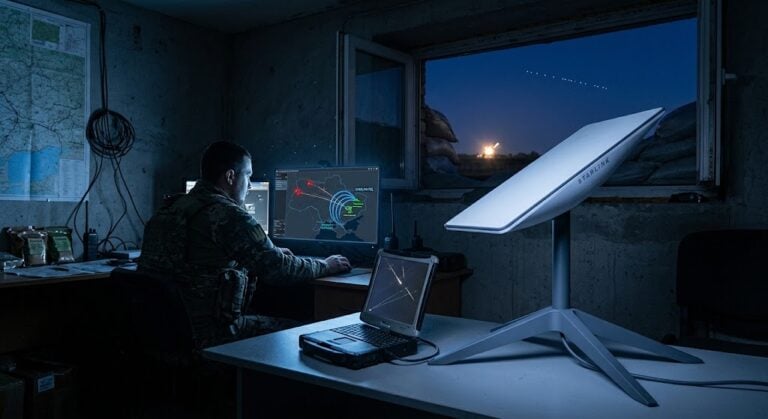
Earlier this week, the Wall Street Journal and CBS both reported that it was Elon Musk – not Donald Trump – who ordered the slowdown of Starshield, the satellite communications system that Ukraine relies on for its drone operations. According to this reporting, the decision was driven by Musk. Trump denies that he ordered the restrictions.
This distinction is very important. It means that Musk, a private citizen and the richest human on the planet, reportedly made a decision that directly affected Ukraine’s ability to defend itself. This move, by itself, is significant.
But what is even more significant is a different fight that may be driving the Starshield conflict. And it has nothing to do with Ukraine bombing Russia’s oil refineries. The fight that we should be paying more attention to is between Musk and the EU and it’s over satellite spectrum.
In May, the European Commission staked out much of the valuable 2 GHz satellite spectrum for European operators, including its own secure communications and defence systems. This particular part of the spectrum will allow ordinary mobile phones to connect directly to satellites. Space X’s existing licences expire in May 2027, and Europe wants to reduce its dependence on American satellite companies.
This would leave SpaceX competing for a much smaller share of the available frequencies. SpaceX objected strongly. In June, it submitted formal objections to the European Commission, arguing that the proposal would restrict competition and could undermine satellite connectivity in Ukraine. SpaceX was already invoking Ukraine’s security in its regulatory dispute with the EU.
SpaceX then began pressing American regulators to consider reciprocal restrictions on European satellite companies operating in the US. On 18 October, the Financial Times reported that Andrew Puzder, Trump’s ambassador to the EU, had warned European companies of potentially “devastating” retaliation if Brussels went ahead with its plans.
Let’s process these events and the timing. Europe told Musk that SpaceX won’t get the satellite frequencies it wants because Europe sees these frequences as strategically important to European security. The US government threatens to punish European companies. And then we learn that Musk personally placed restrictions on Starshield essential to Ukraine’s military operations.
We do not know for certain whether Musk’s decision to slow down Starshield access was meant to pressure Europe over the 2 Ghz spectrum dispute. But the timing, the commercial interests at stake, and the fact that SpaceX had previously used Ukraine as negotiation leverage certainly provides a sound rationale for why Musk would directly intervene.
There are five strategic points coming out of this episode that are worth thinking through.
1. Musk, an unelected U.S. citizen, is deciding Ukraine’s fate.
The Starshield restrictions have disrupted Ukrainian drone operations, including its ability to intercept Russian attacks. This happens to suit Trump who wants Zelensky to stop bombing Russian oil refineries, but it appears that the real target of Musk’s decision is not Ukraine, but the E.U. Musk is well aware the Europe is bankrolling this war and that the fate of Ukraine is of strategic interest. This is a remarkable amount of leverage for single private individual to exercise over the course of a war.
2. The 2 GHz satellite frequencies that Europe wants to reclaim are extremely valuable.
Control over the 2 GHz spectrum matters for the future of global telecommunications. SpaceX wants to move beyond providing broadband through Starlink terminals. The next step is satellite-to-mobile communication. Musk has already invested billions in building the satellite infrastructure but SpaceX requires the right frequencies to make the system work. This would allow for a mobile connection from any spot on Earth. The commercial market is worth billions.
For Musk, cutting off access to this spectrum could prevent SpaceX from becoming the world’s most important telecommunications provider. Just as worrying for him is that the European Commission decision could spur other countries to follow suit and reserve their own strategic frequencies.
3. SpaceX controls ~75% of the world’s satellites.
That’s an extraordinary concentration of infrastructure controlled by one company, especially when we consider that satellites have become more and more important for communications, defence, intelligence, and military operations. Ukraine is a case in point. The events over the past few days illustrates what happens when a country becomes dependent on a communications system that it doesn’t control.
The Starshield episode exposes the risks of depending on a “partner” whose interests may conflict with those of your country. It shows the public why Europe must develop its own satellite infrastructure and hold on to those 2 Ghz frequencies.
4. Europe and the US are moving towards a direct conflict over Ukraine.
While it’s possible to argue that Trump has continued to support Ukraine since returning to the presidency in January 2025, the direction of travel shows Washington shifting from a pro-Ukraine position to a more neutral position, or even a pro-Russia position. American support for Ukraine has become increasingly conditional. Trump has demanded that Zelensky limit Ukraine’s attacks on Russian energy infrastructure. And Musk’s restrictions on Starshield only shift the American position closer towards Putin. The satellite frequencies dispute further divides America from Europe.
Meanwhile, Europe has come to see Ukraine’s ability to resist Russia as vital to its own security.
5. The war in Ukraine has become existential for Europe.
I don’t think this point is fully appreciated by European publics or American citizens.
When Russia invaded Ukraine in February 2022, it did not start off as an existential war for Europe. However, after four and a half years, control over Ukraine is now existential for Europe.
Ukraine has developed some of the most advanced and battle-tested warfighting capabilities in the world, particularly in drone warfare, electronic warfare and defence manufacturing. Its military and defence industry have adapted at an extraordinary pace, developing technologies and production systems that European militaries are now trying to learn from. All of this has happened as a result of fighting the war and learning invaluable, painful extracted lessons from the war.
As an enemy, Ukraine also understands Russia better than anyone else. It knows how Russia fights, how it thinks, how it adapts and how it intimidates. That knowledge, combined with Ukraine’s military capabilities and defence-industrial supply chains, makes it an enormously valuable strategic partner for Europe.
Consider what happens if Ukraine loses. If Ukraine is neutralised, it risks becoming a buffer state vulnerable to Russian influence, potentially allowing Moscow to expand its reach into Eastern Europe.
But if Ukraine comes under Russian political or territorial control, the consequences could be much more serious. Europe would lose a critical ally, while Russia could potentially gain access to Ukraine’s military expertise, defence manufacturing capabilities, and knowledge of Western military systems. Ukraine the ally could become Ukraine the threat.
****
In Elon Musk, we have a private individual who: controls a major media channel in X, commands infrastructure critical to European security, and has openly interfered with European politics in support of far right parties. Now Musk has reportedly taken a decision that directly affects Ukraine’s ability to defend itself just as Europe has resisted his demands for access to valuable satellite frequencies.
These events might not be connected. But it is a question that deserves proper investigation.
Regardless of Musk’s motivations, the broader strategic problem is clear: Europe has become dependent on critical infrastructure controlled by a private company whose commercial interests may not align with Europe’s security interests. This Starshield incident reveals how our dependence on Musk and SpaceX can be weaponised against us.
Relevant links:
Musk’s decision to restrict Starshield
- Wall Street Journal: Musk Ordered Starlink Slowdown That Blindsided Ukraine
- CBS News (20 October): Musk chose to restrict Ukraine’s access to SpaceX satellite network, sources say
Europe’s spectrum dispute with SpaceX
US threats against European companies